
Wildfires in British Columbia and the Invisible Threat of Smoke to Wine Quality
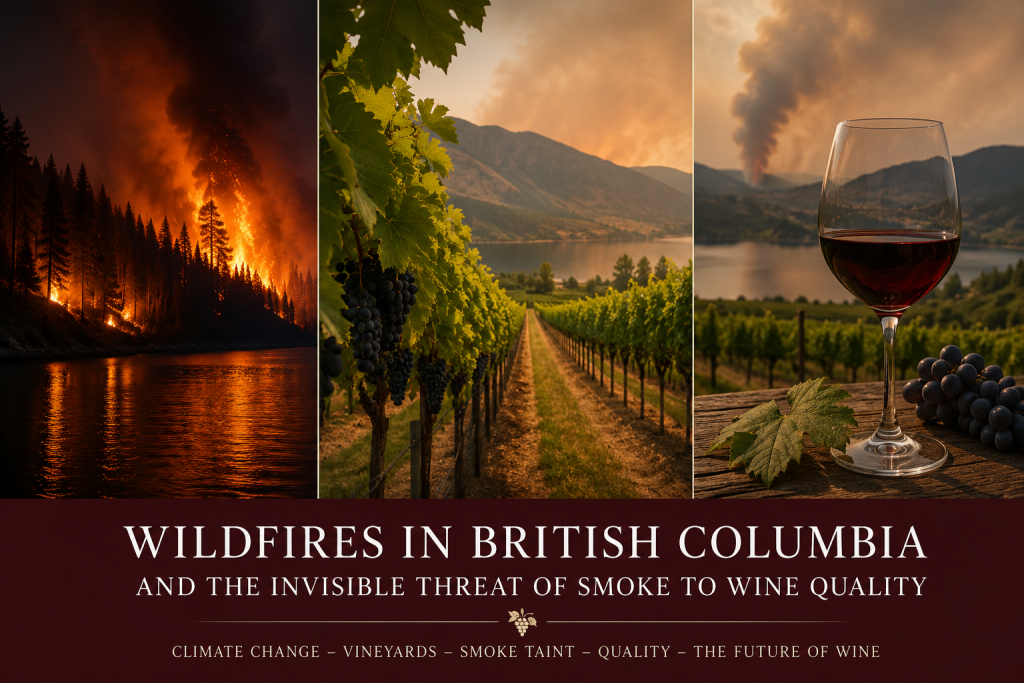
In British Columbia, the summer of 2026 is once again showing how climate change is transforming the relationship between the land, agriculture, and wine.
The wildfires affecting the province represent not only a threat to people, homes, and forests. When fire approaches wine-growing areas, a more subtle and less visible problem emerges: smoke can reach the vineyard and, under certain conditions, compromise the quality of both grapes and wine.
One of the most significant cases in recent days has been the Bald Range wildfire, which developed in the Summerland and Peachland area, in the heart of the Okanagan Valley. The fire grew rapidly, causing one of the largest evacuations of the wildfire season in British Columbia. As of August 10, authorities reported that more than 20,000 people had been evacuated and that approximately 13,600 hectares had been affected by the fire.
However, this area is not only one of the most beautiful parts of the Okanagan. It is also an important part of British Columbia’s wine-growing landscape.
For wine producers, fire presents two completely different challenges: the physical threat when flames reach the vineyard, and the qualitative threat when smoke affects the grapes.
The Problem Is Not Only the Fire
A vineyard may be located some distance from the flames and still experience the effects of a wildfire.
Smoke carries numerous volatile substances produced by the combustion of vegetation. Among these are the so-called volatile phenols, some of the most important compounds associated with smoke taint, an alteration of wine aroma caused by exposure to smoke.
Among the compounds that have been studied are guaiacol, 4-methylguaiacol, cresols, and syringol.
The mechanism behind this phenomenon, in simplified terms, is quite fascinating.
Compounds present in smoke can settle on the surface of the grapes and, particularly during certain stages of berry development, may be absorbed through the grape skins and penetrate the fruit.
Some of these phenols can then bind with sugars naturally present in the grapes, forming compounds known as glycosides.
This is where one of the most insidious aspects of the problem arises: these bound compounds can be difficult to detect or even virtually odourless in fresh grapes.
The problem may reveal itself later during winemaking, ageing, and even during tasting.
In other words, a grape grower may taste a grape that appears perfectly normal and still have no certainty about what will eventually happen to the wine.
Research in British Columbia on smoke taint highlights precisely this issue: the impact depends on the intensity and duration of smoke exposure, the stage of berry development, the grape variety, and the characteristics of the smoke itself.
When Wine Begins to Speak of Smoke
The problem becomes particularly evident during sensory evaluation.
A wine affected by smoke taint may display sensations or aromas of:
- smoke;
- ash;
- burnt wood;
- smoked meat;
- burnt notes;
- medicinal notes;
- bitterness or harshness on the finish.
This does not, of course, mean that every wine produced in a vintage affected by wildfires will automatically develop these faults.
Smoke does not necessarily mean that a wine is contaminated.
The BC Wine Grape Council itself emphasizes that the simple presence of smoke odours in the environment does not automatically mean that smoke taint will be present in the wine.
Many factors must be considered: the distance from the fire, the duration of exposure, the concentration and composition of the smoke, the stage of grape development, and the grape variety.
The Timing of Exposure Is Crucial
Not all stages of grape ripening carry the same level of risk.
Research indicates that exposure during certain stages of berry development can be particularly significant.
This means that it is not enough simply to say:
“The vineyard was exposed to smoke.”
The right questions should be:
When? For how long? At what intensity? What type of smoke was involved? And at what stage of ripening were the grapes?
This distinction is also essential in order to avoid unnecessary alarm.
Why Red Wines May Be Particularly Sensitive
There is also an important difference between white and red winemaking.
In the production of red wines, the must generally remains in contact with the grape skins during fermentation and maceration.
If certain smoke-derived compounds are present on, or have been absorbed by, the grape skins, greater extraction may contribute to their presence in the wine.
In white wines, where contact with the grape skins is normally much more limited, the process may be different.
However, this does not mean that white wines are immune.
Sensitivity also depends on the grape variety, vineyard conditions, and winemaking techniques.
The Problem Often Appears After the Harvest
This is perhaps the most worrying aspect for a wine producer.
The economic damage is not necessarily limited to the loss of grapes directly caused by the fire.
A batch of grapes may be harvested, transported to the winery, crushed, and fermented, only to develop undesirable characteristics later on.
For this reason, the wine industry is now paying increasing attention to laboratory analysis.
Producers can test for the main markers associated with smoke taint and, based on the results, decide how best to proceed with the winemaking process.
The Australian Wine Research Institute, which has developed extensive international expertise on this issue, recommends, for example, analysing grapes exposed to smoke before harvest, allowing sufficient time to obtain the results and make informed decisions.
Can the Problem Be Eliminated?
The answer is: not always completely.
There are several winemaking strategies that can help reduce the impact of smoke taint, including limiting skin contact, clarification techniques, filtration, and certain specific treatments.
However, each intervention may also have consequences for the structure, aromas, and overall balance of the wine.
The real objective, therefore, should not simply be to “remove the smoke,” but rather to preserve as many of the wine’s positive characteristics as possible.
This represents an important technical challenge for the winemaker.
What About the Okanagan?
The Okanagan represents a particularly interesting case.
Over the years, the region has developed a strong wine identity, based on a relatively dry climate, significant day-to-night temperature variations, and conditions that allow for the production of wines characterised by freshness, aromatic intensity, and good structure.
However, this very territory is now increasingly facing high temperatures, drought, and wildfires.
The issue, therefore, does not concern the 2026 vintage alone.
Wildfires have become a variable that the wine industry must learn to incorporate into its planning.
The British Columbia Wine Grape Council itself is supporting and monitoring research dedicated to predicting, preventing, and mitigating the effects of smoke on grapes and wine. In 2026, specific studies have also continued to examine how exposure to smoke can influence the aroma of wines.
From the Consumer’s Point of View
What, then, should someone do when purchasing a bottle of wine from British Columbia?
First of all, there is no reason to automatically be afraid of a vintage affected by wildfires.
A wildfire in the region does not mean that all vineyards have been affected in the same way and, above all, it does not mean that all wines will show signs of smoke taint.
Wine is the result of a complex chain of factors: territory, grape variety, climate, ripening, harvest, winemaking, and storage.
Wildfires now add another variable to this equation.
For consumers, it therefore becomes even more important to know the producer and to rely on the transparency of the winery.
Wine as a Reflection of a Changing Territory
Perhaps this is the most interesting aspect of all.
For centuries, we have spoken about wine as an expression of terroir.
Soil, climate, exposure, altitude, grape variety, and human work all contribute to determining the character of a wine.
Today, however, we must add a new question:
How does terroir change when the climate changes?
The Okanagan is offering us an answer before our very eyes.
Fire can destroy a vineyard in just a few hours.
Smoke, on the other hand, can leave a much more subtle trace: a molecule, an aroma, or a sensation on the palate that may emerge months after the harvest.
This is why wildfires in British Columbia are not merely an environmental issue.
They are also a viticultural, winemaking, economic, and quality-related issue.
Because when fire reaches wine country, we must not concern ourselves only with the flames we can see.
We must also learn to recognise what smoke leaves behind in the grapes and, perhaps, in the glass.
Leave a Reply