
Claudio Perazzo, Not just a butcher, but a pork butcher. (Macellaio e Norcino)
We are in Canada in the Okanagan Lake area, a very large lake with a picturesque landscape among the vineyards that surround its shores, I would dare say a “Gardesano “ Landscape (Lake Garda landscape).
We’re in Kelowna, a tourist town. Today we’re in the company of Claudio Perazzo, not just a butcher (macellaio) but also a pork butcher (norcino). Claudio has always been in love with Canada for its pristine nature and for what this country represents in so many ways.
This big step was taken as a great challenge and desire for renewal, but also with his daughters’ future in mind.
In Italy, he lived in Sestri Levante, in the province of Genoa. His profession began at the age of 18, opening his own butcher shop with a friend at the age of 24 in his hometown. Since then, the world of meat and cured meats has been a vital part of his daily life, always striving for innovation and excellence in his work.
Claudio and his family immigrated to Canada in November 2015, directly to Kelowna, one of the most beautiful cities in Canada, recently named a UNESCO World Heritage Site, the only one in Canada to have this recognition.
His first job was at Valoroso Food, and as is naturally required of every immigrant, it is mandatory to have found a Canadian employer before arriving. It was certainly a great new work experience, but not enough to satisfy his desire to be an entrepreneur in Canada.
This dream/project came true in the spring of 2017, when, after carefully studying the world of local food and especially observing the preferences and habits of people in Canada, Claudio founded “Italian Meat Master”, producing only fresh sausages, retail and wholesale, making a series of traditional family recipes and many others with very popular ingredients from our culinary tradition that are very popular in Canada.
At the beginning, there were only seven recipes, now there are over twenty! “I like to think outside the box,” he says, and the creation of sausages that contain various and refined ingredients has given rise to a new type of cured meats that, once cooked, become a real dish to be enjoyed. Naturally, avoiding any preservatives, additives, or allergens, only the highest quality ingredients, making an absolutely healthy and natural product.
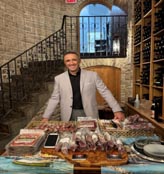
Aged cured meats, on the other hand, arrived a little later, because they required more in-depth study and testing of the climatic conditions and types of meat that can influence the final result. Naturally, only very traditional Italian recipes and fermentation and curing processes were used, preserving our great historical and cultural heritage of our Norcineria (the art of cured meat production).
Claudio told me that knowing he was moving here with his family, he thought it would be a good idea to take a two-level course as a technical cured meat taster. This course was very useful for him to gain a deeper understanding of the technical aspects of each type of cured meat, an important technical background for improving the production of his cured meats, and no less for making his own technical judgments.
In Italy, tasters’ licenses (whether for wine, cured meats, cheeses, oils, etc.) are recognized by the Ministry of Agriculture, Food, and Forestry. This doesn’t exist in Canada. One thing all technical tasters (whether for wine, cured meats, cheeses, oils, etc.) possess is a deep understanding of the sensory system, which allows us to evaluate a product. For example, to be a mechanic, a person must know an engine; the sensory system for all technical tasters is like the engine for mechanics.
-Claudio, how did you find this sector compared to ours in Italy?
The cured meat and cured meat sector in Canada isn’t a shining example of excellence because even Italian producers who make various types of cured meats do so on a large scale, especially in Ontario. The quality of their products is very “commercial,” suited, however, to former North American needs and standards, or simply influenced by their area of origin in Italy. Nowadays, I believe customers are much more informed and demanding, which is precisely why high-quality artisanal products like ours are highly sought-after and appreciated, at least in the Okanagan and Vancouver areas, where the community is decidedly more advanced than in other parts of Canada.
-Why are our meat cut maps more specific?
Our cuts are much more varied because Italian recipes are based on specific cuts of meat, and this has shaped the art of butchering. In North America, although meat consumption is higher than in Italy, cooking and dining are simpler, resulting in a demand and supply of much simpler cuts of meat and, consequently, a quicker butchering process.
-Can you explain why horse meat is hard to find?
I think you can find horse meat in Alberta, but I’m not sure. Horses are simply seen as working or sport animals; therefore, they’re not considered “meat to be consumed at the table.” Canada is so rich in game, such as elk, deer, and bison, that there’s certainly never been a need to consume horse meat on a regular basis. Moreover, even in Italy, it’s not so widely consumed; in regions like Liguria, Tuscany, and many others, horse butchers have practically disappeared these days. Even in Ontario, despite the huge Italian community, I think it’s hard to find.
-Can you describe in just a few words what ONAS (Italian Organization of Technical cured meat tasters ) is and its importance?
ONAS has helped me greatly deepen my knowledge, further fueling my passion for the world of salumi and the historical context that gave rise to it. It has many members in Italy and performs a very important role: preserving a cultural and gastronomic heritage. Naturally, everyone involved in the food sector should be part of it to improve their professionalism, including through the training courses ONAS provides for its members.
-Do you think offering courses to learn how to taste cured meats is important?
I think information is crucial for consumers, and it’s our duty as producers and lovers of our work to spread it. This can also be done through courses, as is regularly done with wine. Recognizing the quality of what you eat or drink must be” a must”.. At Okanagan Italian Meat Master, we organize food and wine pairings at wineries, where for a limited number of people we offer tastings of our cured meats, each served with a different wine from their own production, to enhance their flavors and provide a truly informative and sensory experience.
When you make a handcrafted product with unique aromas and flavors, the pairing is always a success. People really appreciate it, and it often changes their approach to cured meats. Just last week, we were guests at Mission Hill, offering a large selection of our cured meats and a couple of their high-end events. They even asked me to make them a sausage in red wine, which the chef then used to make a delicate sauce, served over a creamy polenta base. Each dish was accompanied by their most prestigious wines, such as their 2014 and 2021 Oculus.
-It could be interesting, with ONAV, to create courses on cured meats and wine pairing based on the context of why this choice is made. No choice happens by chance.