
ONAV Technical Tasters Evaluation Sheet – Sommelier Evaluation Sheet
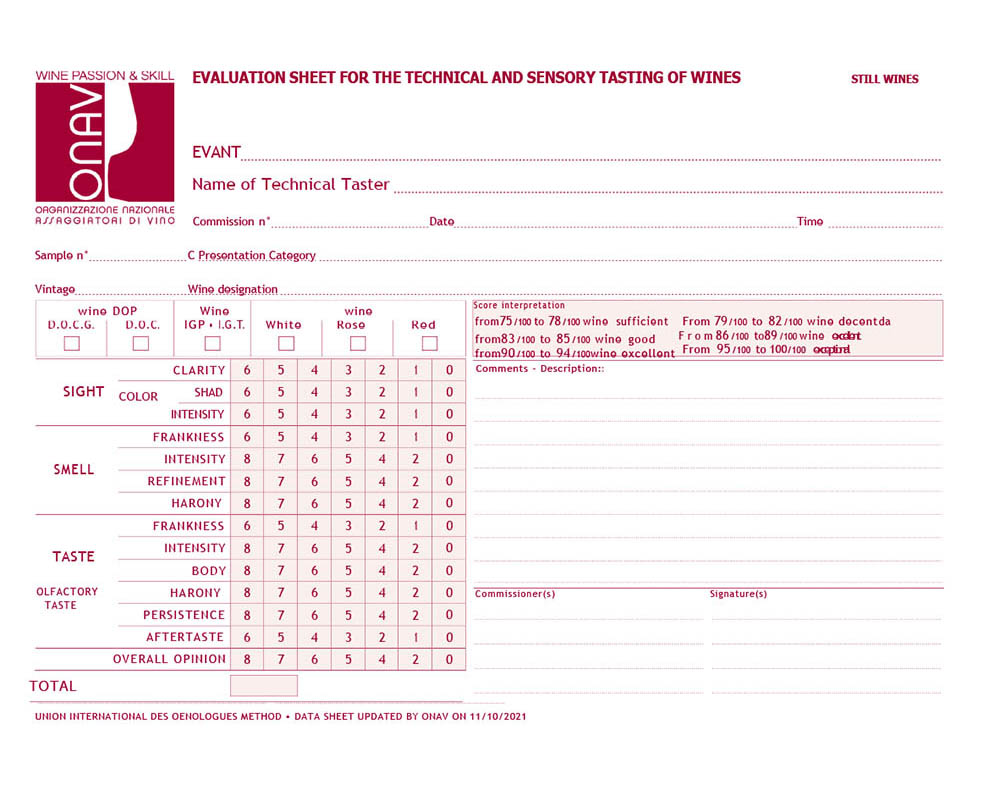
The ONAV Technical Tasters’ Evaluation Form is inspired by that adopted by the Union International des Oenologues; it is not a descriptive form of specific parameters or descriptors of a wine. It focuses primarily on the technical and objective analysis of the wine’s characteristics, using a standardized form to evaluate aspects such as appearance, aroma, flavor, and structure. Therefore, we won’t find phrases like “strawberry notes with hints of ripe fruit and licorice.” Instead, we will find a quantitative evaluation that yields an overall numerical rating of a wine in hundredths. Just as it is extremely difficult for a student to get a 10 in school, it is equally difficult for a wine to get a 100/100. Therefore, a wine with a score of 94-96/100 is close to perfection, while a wine with a score of around 80/100 is already bordering on decency.
Sommeliers, on the other hand, in addition to sensory analysis, also take into account elements related to the culture, history of wine, and above all food and wine pairing, applying a broader and more personalized evaluation.
More detailed analysis:
ONAV evaluation sheets:
Technical and objective approach:
ONAV sheets are structured to evaluate wine according to standardized and objective parameters, with the aim of providing a technical and precise assessment of its characteristics.
Focus on sensory analysis:
The focus is primarily on the sensory aspects of wine, such as visual appearance, aromatic intensity and complexity, structure, and mouthfeel.
Use of specific terminology:
ONAV reports use precise technical terminology to describe wine characteristics, facilitating communication between technical tasters and standardizing evaluations.
Objective:
To provide an objective evaluation of wine, useful for classification, certification, and comparison between different wines.
Sommelier evaluation sheets:
Broader and more personalized approach:
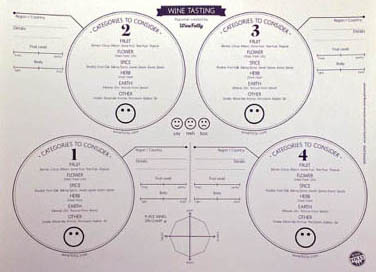
The sommelier’s profiles integrate sensory analysis with elements related to the culture, history of wine and the taster’s personal experience
Focus on food and wine pairing:
A fundamental aspect for the sommelier is the ability to evaluate the wine and food pairing, considering the characteristics of the wine and the dish to create a harmonious gastronomic experience.
Subjective and contextualized evaluation:
The sommelier’s evaluation can be more subjective, taking into account the context, the type of wine, and personal preferences.
Objective:
Provide personalized and comprehensive wine recommendations, taking into account the wine’s characteristics, context, and customer preferences.
In short,
ONAV focuses on the technical and objective evaluation of wine, while the Sommelier adopts a broader and more personalized approach, integrating sensory analysis with elements related to culture, history, and food and wine pairing.