
The history of the amphora is rooted in millennia of Mediterranean civilization and is closely intertwined with that of wine. Considered for centuries the preferred container for storage and transportation, the amphora also represented a veritable visual language: during the Roman Empire, shapes varied depending on the region of origin, allowing the wine’s provenance to be immediately identified. A sort of ancestor of modern Appellations.
After periods of neglect, especially in Italy, amphorae have returned to the spotlight thanks to a new generation of producers and pioneers like Josko Gravner, considered the master of orange wines, who revived the use of Georgian qvevri worldwide. Today, talking about amphora wines means describing a complex universe: the differences concern not only grape varieties, soils, and terroirs, but also the role the amphora plays in the production process. Some use them for fermentation, others only for aging, some age their wines entirely in them, and others use them for a brief period; not to mention the variety of amphorae themselves, in terms of shape, volume, material (terracotta or stoneware), and degree of porosity.
It is within this ever-evolving landscape that the work of Dr. Gianluca Di Loro, a young and talented winemaker and owner of Dilorowines winery in Niagara Falls, Ontario, fits in. His choice to introduce amphora into the production process stems from a meticulous technical approach and a precise stylistic vision.
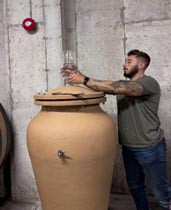
“We have often worked with amphora,” explains Di Loro, “and we prefer to use very low-porosity containers, which promote controlled micro-oxygenation. This allows the wine to mature more slowly, gradually, and harmoniously, preserving and enhancing the floral aromas, which are particularly important in Pinot Noir.”
Unlike other producers who also use amphora for fermentation, Di Loro favors a more cautious and targeted approach:
“We use amphora only for aging, because we seek extremely clean wines, capable of long-term maturation without alterations. We avoid any risk of increasing volatile acidity, keeping it well below the perceptible threshold. Amphorae are delicate to clean, and the porosity of the terracotta poses a potential microbiological risk. For this reason, we prefer to use them for wines that are already stable.”
According to the winemaker, the sensory difference between a wine aged in amphora and one produced using traditional techniques is clear, but not artificial:
“The amphora offers a contribution that we might define as intermediate between steel and wood. Like the barrel, it allows for micro-oxygenation that enhances aromas, softens tannins, and stabilizes color, but—unlike wood—it does not release aromas of vanilla, cocoa, or spices. From a sensorial standpoint, it behaves like an inert material, just like steel: it adds nothing, but preserves everything.”
The result, Di Loro states, is a wine that maintains its varietal purity while gaining elegance, balance, and longevity.
The millennia-old history of amphorae, therefore, finds new life in the work of winemakers who look to the future without forgetting the most ancient roots of winemaking culture. Among these is Dr. Gianluca Di Loro, who, in addition to directing Dilorowines, will also serve as technical director of future ONAV courses, bringing with him a wealth of knowledge that combines tradition, research, and innovation.