
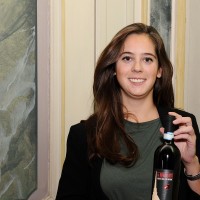
31 Years old, an oenologist and researcher, Dr. Camilla De Paolis is now Director of the ONAV National Headquarters. Following Dr. Francesco Iacono, a new chapter begins in the history of the Italian Organization of Technical Wine Tasters.
Seventy-five years of history represent an important heritage, but also a responsibility towards the future. ONAV, founded in 1951 with the aim of promoting wine culture through technical knowledge and tasting, has built its own identity over the decades, based on education, expertise, and the ability to understand wine through its organoleptic and technical characteristics. Today, this history is entering a new phase.
At the helm of the ONAV National Headquarters is Dr. Camilla De Paolis, from Turin, 31 years old, an oenologist and researcher. Her presence represents an important new development in the history of the Organization and marks the transition towards a new generation. Her arrival follows the path of Francesco Iacono, who led ONAV through a significant phase in its development.
But the real significance of this transition lies not simply in the age of the new Director or in the fact that she is a woman. It lies above all in her professional background, her education, and the ideas she brings with her.
Dr. Camilla De Paolis’s career is deeply connected to oenological education and scientific research. She developed her academic work in the field of Agricultural, Forestry and Food Sciences at the University of Turin, dedicating her research to topics related to the production and traceability of high-quality wines.
Her scientific work also includes topics related to oenological technology, wine composition, and the effects of climate change on wine production and winemaking processes. It is a background that brings together two fundamental dimensions of the world of wine: scientific knowledge and sensory knowledge.
Contemporary wine, in fact, can no longer be described through tasting alone. Behind every glass lie viticulture, chemistry, microbiology, production technologies, terroir, sustainability and, today more clearly than ever, the effects of climate change.
The technical knowledge of the wine taster remains fundamental, but it must engage with a scientific and production environment that is changing rapidly. It is precisely in this space that an oenological and scientific education can represent an important asset for an organization such as ONAV.
ONAV has a clear and distinctive history. Its mission is to train Wine Tasters and Sommeliers and to promote wine culture through technique and method. After 75 years, however, the world in which this mission must be carried out has changed profoundly.
Wine has become increasingly international. Markets are changing, consumers are changing, technologies are changing, and the ways in which younger generations approach wine are also changing. For an organization with such a long history, the challenge is not only to preserve its heritage, but also to find ways to pass it on to future generations.
This is where the new direction may become particularly interesting.
Innovation does not necessarily mean erasing what came before. In the world of wine, innovation can mean preserving the method, seriousness and expertise built over time, while at the same time opening them up to new tools, new forms of communication and new people.
Among the ideas presented by Dr. Camilla De Paolis in the recent profile published by Corriere della Sera are a greater openness to the English language and a particular focus on younger generations, with the idea of creating a space dedicated to people under 40.
These are two directions that deserve attention. English, first and foremost, means opening education to an international audience. Those under 40, on the other hand, mean asking how to speak to a generation that does not necessarily have the same relationship with wine as previous generations.
These are two different aspects, but they are connected by the same question: how can a great tradition become contemporary without losing its identity?
For those who experience the ONAV world outside Italy, this question takes on an even more concrete meaning. In Canada, as in other countries, wine is encountered within an international, multicultural and multilingual environment. Knowledge of Italian wine can therefore also become a tool for dialogue between cultures.
For this reason, ONAV’s international outlook is a topic that directly concerns Canada as well. ONAV Canada is following this evolution with attention, not only because it represents part of ONAV’s presence around the world, but also because it shares the need to bring the culture of technical wine tasting and wine knowledge to people living outside the Italian environment.
Dr. Camilla De Paolis therefore takes on the role of Director at a time when ONAV is undergoing important changes. After 75 years, the challenge is not to choose between tradition and innovation. The real challenge is to understand how the two can work together.
Tradition brings with it ONAV’s heritage: technical tasting, education, method and many years of experience. Innovation can bring new forms of communication, new generations, greater international openness and an increasingly close relationship with research.
This is the space in which Dr. Camilla De Paolis now finds herself: 31 years old, with a background in oenology and scientific research, and with a new responsibility at the helm of the ONAV National Headquarters.
The future will determine what form this new phase will take. But the transition has already taken place.
A new generation has taken the helm of ONAV. And with it, a new chapter in the history of the Organization begins.
Augusto O.